Regions

US (34) Europe (9) international (9) Latin America (7) Asia (4)
Showing posts with label energy. Show all posts

Sunday, August 19, 2012

The Quandary of Air Conditioning

Article: New York Times, The Cost of Cool by Elisabeth Rosenthal

Here's another vicious circle for you: as the populations of tropical developing nations move into the middle class, they will demand air conditioned homes, offices and cars, just like Americans do.  This will  contribute to global warming, which will further increase the demand for air conditioning, until... What?

Elisabeth Rosenthal's article is informative and thought-provoking.  It does not simply bash our decadent comfort-seeking life-style, but notes that air conditioning brings benefits for our health and productivity, and seems to be a requirement for modern knowledge workers, especially in hot climates.  This is a quandary, for which there is no simple obvious solution.

One more thing to puzzle and worry about...

http://graphics8.nytimes.com/images/2012/08/19/opinion/19rosenthal_chart/19rosenthal_chart-custom1.png

Thursday, September 22, 2011

More to Worry About: Russia Commits to Chernobyl-Style Reactors

Article: Wall Street Journal, Russia to Extend Life of Aging Reactors, by David Crawford and Rebecca Smith

To take my mind off the 400+ drop in the Dow Jones Industrial Average, I was thumbing through the international section of the paper, and found this article about nuclear reactors in Russia.

Despite Western pressure to shut them down, there are still 11 Chernobyl-style reactors, also known RMBK reactors, operating in Russia.  All of them are on the Western edge of Russia, near the cities of St. Petersburg (pop. 4.8 million), Smolensk (pop. 327,000) and Kursk (pop. 415,000).  These reactors originally had a life-span of 30 years; they have now been extended to 45 years.


from www.wsj.com


As per the article: "Many Western nuclear experts believe the RMBK reactors are among the world's most dangerous and still suffer from fundamental design shortcomings."  Such as:
  • No containment structure to keep in radiation in case of an accident.  A containment structure is a standard feature on modern nuclear reactors.
  • No central crucible to hold fuel rods.  Each fuel rod sits in its own tube, so engineers have to monitor and maintain 1,000 separate tubes, instead of one central crucible.
Although Russia is rich in natural gas, they are reluctant to replace their aging stock of Soviet-era nuclear reactors with natural gas plants, because they prefer to export their natural gas for profit.

I hope that Europe will become less reliant on Russian natural gas soon, and that this will change the equation.  In the meantime, let's all keep our fingers crossed.


Monday, September 12, 2011

Bashing President Obama and Pushing Dirty Energy

Article: Wall Street Journal, Canada's Oil Sands are a Jobs Gusher, by Mary O'Grady

I'm glad that in his speech on Thursday President Obama didn't say a word about green energy jobs.  As I said in a previous post, I'm fairly convinced that subsidies for forms of energy that are not yet economically viable (e.g., solar and wind) are a waste of taxpayer money.   (Research, on the other hand, is another story).

It seems like Ms. O'Grady, a columnist for the Wall Street Journal listened to a different speech than I did, or perhaps she didn't listen at all, just trotted out the old cliches one more time.  Here is the first paragraph of her article:
For all its soaring rhetoric, President Obama's "jobs speech" last week didn't demonstrate a lick of insight into why economies grow or how wealth is created. It was merely trademark Obamanomics: using government diktat to move money that's over here, over there.

What is she referring to, exactly?  Cutting payroll taxes?  I thought conservatives believed tax cuts were the key to prosperity.  Investing in infrastructure projects a la Eisenhower?  Investing in education?  Cutting government red tape and streamlining regulation?  Yes, these were the core elements in the President's speech.  

She mentions Alberta's oil sands as an example of the type of exploration that will lead to increased jobs, then blasts Obama for allowing regulators to slow down drilling on Federal lands.  My understanding is that the oil sands remained unexploited for years is because the oil that they contain is filthy, expensive to exploit and high in greenhouse gases and replete with negative environmental effects.  The only reason Canada has had success with this energy source in the last few years is that the cost of imported oil has gotten so high.  But what is the way forward for our energy future?  Clean natural gas from the U.S.?  Maybe.  Dirty tar from Canada?  Highly doubtful.

Ms. O'Grady also mentions that the market tanked 300 points the day after Obama's speech.  Come on!  Anyone following the market that day knows that this move was all about Europe, notably the highly scary resignation of German ECB official Jurgen Stark.  As I recall, the market was up on Friday morning (largely on Obama's well-received speech and plan) before this news hit.

Obama's plan is not the be-all end-all, but it is a practical, centrist step in the right direction, which may actually have a chance of passing.  Given budgetary constraints and a divided government, this may be the best we can hope for right now.  

If Mary O'Grady wants to criticize the speech, perhaps she should start by actually listening to it.  


Friday, September 09, 2011

The USA's Aging Energy Infrastructure

Articles:
Wall Street Journal, Nuclear Backlash Energizes Old Plants, by Rebecca Smith
Wall Street Journal, Gas Pipeline Operators Sweat Test, by Daniel Gilbert

Two articles in Thursday's WSJ about the USA's aging energy infrastructure.

The first points out that the anti-nuclear backlash caused by the Fukushima disaster in Japan is stalling construction of new nuclear reactors around the world, which will have the perverse effect of increasing our reliance on an aging stock of nuclear power plants.  The U.S. produces more nuclear power than any other country in the world, with 104 power plants.   Ground was broken on virtually all of these in the 1970s.  They were originally licensed for use for 40 years, but according to the article, over 70 of the plants have already received 20 year extensions.  Are 60-year-old nuclear reactors safe?  I hope so.  Meanwhile, regulators are conducting research to see if it would be feasible to operate a nuclear reactor for as much as 80 years.

from WSJ.com


The article also points out that the energy industry has been finding it more attractive to construct natural gas fired plants as an alternative to nuclear plants.  This sounds reasonable, except that over 60% of the U.S.'s natural gas pipelines were built before 1970--around 178,000 miles worth.  A large portion of these older pipelines were never subject to pressurized water tests for leaks.  The test became a requirement after 1970.  Now regulators are considering making the industry go back and perform this test on all of the old pipelines.  At between $125,000 and $500,000 per mile, the cost will be in the tens of billions.

I don't have the expertise to say how safe it is to continue using nuclear facilities and gas pipelines for 40, 50, 60 or more years.  But it's pretty surprising to learn how truly old our country's energy infrastructure is.

Friday, September 02, 2011

Is Green Energy a Waste of Our Money?

Article: Wall Street Journal, 'Green Jobs' vs. Real Energy Jobs, by Stephen Moore

The author of the above article is a member of the Wall Street Journal's editorial board, which will give you some idea of his politics.  I am embarrassed to say that I am largely in agreement with much of what he says.  In the near future I may have to blog about a couple of New York Times editorials and perhaps an Atlantic Monthly piece to wash the bad taste from my mouth.

Moore argues that the administration has spent large amounts of stimulus money on green energy projects that basically could never work, while putting roadblocks before technologies like fracking for natural gas which have the potential to generate decades worth of (relatively) clean energy to our country and are already providing jobs.

I understand that fossil fuels are dirty, bad for our planet and bad for our health.  But natural gas is much cleaner than coal, and fossil fuels obtained locally are vastly preferable to petroleum imported from countries like Saudi Arabia.  I remember when President Obama was campaigning, he talked about three long-term priorities: education, health-care, and energy independence.  We shouldn't forget this last priority, which would have saved us all manner of economic and political headaches over the last 50 years.

I agree with many of the arguments made by Matt Ridley in his book "The Rational Optimist", that fossil fuels have largely been the basis for the last 200 years of remarkable human progress, and , that throughout history "renewable" energy has been a synonym for human, animal or wood power, which is another way of saying poverty, misery and back-breaking subsistence farming.  Not to mention that with a world population approaching 7 billion, the environmental impact of the above would be far more devastating than any coal, oil or gas-fired future.

Now obviously the ideal of something like solar power is to generate oodles of clean, cheap energy.  The problem is, it has been a pipe dream for the last 50 year and has not yet panned out.  It is not viable.  Can it be in the future?  Maybe, but not yet.  So why should the government pay me to put an inefficient solar panel on my roof, the pre-tax cost of which is greater than the cost of the energy I save?  Isn't that just throwing our money away?

I am all for research and development, and certainly the government should be funding renewable energy research projects in our nation's great research universities.  But until green energy is economically viable, I wonder is it really a good basis for economic stimulus?

As far as fossil fuels go, I don't believe in tax breaks for oil companies, but neither do I believe in distorting markets by imposing things like fuel economy standards by fiat.  Let's tax fossil fuels so that their price will include the full cost of the damage they inflict on human health and the environment.  Then it will be in everyone's interest to use less, conserve, and find cleaner alternatives.  I have read that this is politically impossible, but that doesn't stop it from being the right way to use energy wisely.

In the meantime, why turn our backs on the stated long-term goal of energy independence when it may be realistically in sight?

Tuesday, August 30, 2011

Can Germany Do Without Nuclear Power?

Article: New York Times, Germany Dims Nuclear Plants But Hopes to Keep Lights On, by Elisabeth Rosenthal

Germany's Biblis Nuclear Plant, from www.spiegel.de


An article in today's NY Times notes that Germany has already shut down 8 of its 17 nuclear reactors, and plans to close the rest by 2022.

This was a reaction to the Fukushima disaster in Japan.  That a mishap of this scope could take place in a developed country has really spooked Germans.

Germany has been aggressively pursuing green energy and today gets 17% of its electricity from renewable sources (wind, solar and bio fuels) although the first two are somewhat unpredictable as they are highly dependent on weather conditions.  Skeptics say that Germany's energy plan will lead to higher energy prices, higher emissions, and has already caused it to import more electricity from France and the Czech Republic--countries that use nuclear plants to generate much of their electricity.

The German plan estimates that electricity from renewable sources will double in the next ten years, but also calls for the construction of additional coal and gas-fired plants.

Japan is already backing off its initial pledges to completely phase out nuclear energy.  It will be interesting to see if Germany will follow through with theirs.

Thursday, August 25, 2011

Why Does the SEC Care About Fracking?

Article: Wall Street Journal, SEC Drills Down on Fracking, Deborah Solomon

Interesting article today on page one of the WSJ's Marketplace section.  "Fracking" is short for hydraulic fracturing, the somewhat controversial practice by which shale-based natural gas is extracted by pumping water, chemicals and sand into deep underground wells (see earlier post Natural Gas: Fracking in Europe).


Many environmentalists, and groups living in areas where fracking is being carried out, have raised concerns that the practice pollutes groundwater, and that the chemicals used are not fully disclosed.  Now the U.S. Securities and Exchange Commission (SEC) is stepping in, asking for "detailed information about oil and gas companies' hydraulic fracturing operations, including environmental impacts."

Which raises the question: why the SEC?  The SEC's mission is to: "...protect investors, maintain fair, orderly, and efficient markets, and facilitate capital formation."  Wouldn't this be better left to the Environmental Protection Agency (EPA), whose mission is "..to protect human health and the environment"?

SEC Head Mary Schapiro
Perhaps so, but after reading the article I came to a better understanding of the SEC's concern here.  "Government officials said the SEC's interest in fracking is in ensuring investors are being told about risks a company may face related to its operations, such as lawsuits, compliance costs or other uncertainties."  I always wondered how much faith I should put in the part of the annual report where management discusses risks--how can an investor be sure that this discussion is honest and complete?  After all, if management wants the stock price to go up, they might feel a temptation to downplay risks and put a happy face on future prospects.

To the extent that the SEC causes management to be honest about risks, it's good for investors.  On the other hand, to the extent that they require companies to disclose similar information to multiple agencies, it is an inefficient regulatory compliance burden which costs money both for the company being regulated and for the taxpayers who fund the agencies doing the redundant work.

EPA Head Lisa Jackson
It's a tough call.  Oil and gas companies use toxic chemicals in their operations which are to a certain extent undisclosed, because they say the exact formula represents a "trade secret", like the top secret formula for Coca Cola syrup.  I would say the public has a pressing interest in knowing this information.  Ideally, information on practices with potential environmental effects should be disclosed to the EPA, these disclosures should be publicly available, and the SEC should make sure that management is not distorting or downplaying this information on their disclosures to the market.  But if the EPA --which is often accused of being a jobs killer and is funded from the vulnerable "discretionary" budget-- can't get the job done, then I applaud the SEC for stepping up and doing something that protects both investors and the general public.

Many people believe that shale-based oil and especially natural gas will be a resource of major importance to the United States in coming years.  The size of these unconventional reserves is compelling, and will be examined in future posts.  It is already a provider of jobs in some regions (see CNBC report Unemployed? Go to North Dakota).  But the risks to public health and the environment must be addressed.


Friday, August 19, 2011

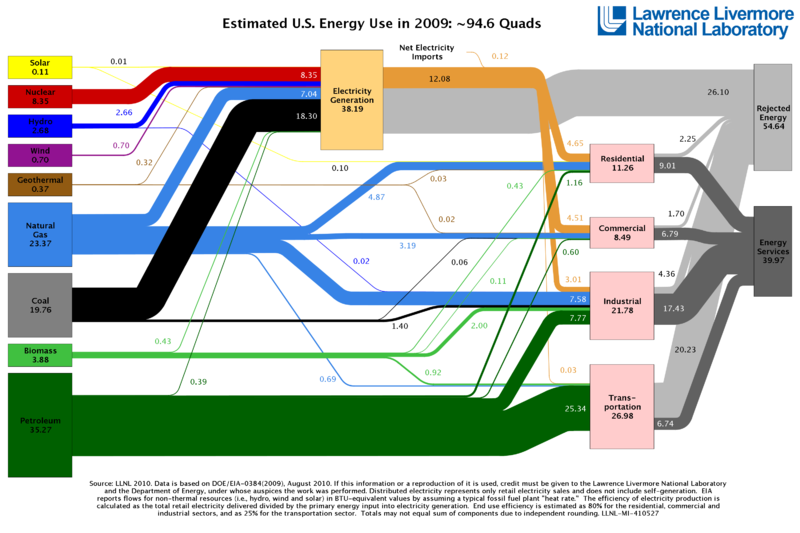
U.S. Energy Sources and Uses

Here is a very interesting chart from the Lawrence Livermore National Laboratory, that gives a great panoramic view of how energy flows in the U.S (click on it to expand).  Note that a quad means 1 quadrillion Btu -- that's 1 with 15 zeros.


Bloomberg.com also has an interactive version of the same graphic, with links to additional information, created by John Tozzi and David Yanofsky --most interesting: U.S. Energy: Where It’s From, Where It Goes, and What’s Wasted


Fossil Fuel Production and Use: Lots of Fun With Charts

This chart is a combination of three that I posted previously which give an overview of which countries produce and consume the most coal, oil and natural gas.


To make the above chart, I had to convert the coal, oil and gas numbers--which were denominated in short tons, barrels per day, and cubic feet--into the common unit of BTUs (British Thermal Units).  Arriving at the conversion factors can be a fairly technical exercise, of which there is good discussion here: http://www.aps.org/policy/reports/popa-reports/energy/units.cfm

I used the following factors, which were suggested as averages:
Oil: 1 barrel = 5.8 MBtu
Coal: 1 short ton =  25.2 MBtu
Natural Gas: 1 cubic foot = 1000 Btu

Global Natural Gas Production and Consumption

Over the last couple of weeks I published charts based on data from the U.S. Energy Information Administration that showed various countries' production and consumption of coal and oil.  Today I turn to the third fossil fuel, one which is gradually growing in importance in the U.S.: Natural Gas.


Natural gas is a resource which is mainly used for heating homes, industrial uses, and electrical power generation.

The chart shows that the U.S. and Russia are the largest producers of natural gas.  Russia exports a great deal of natural gas, while the U.S. consumed slightly more than it produced in 2010, although this may change in coming years, as the U.S. taps its huge supply of unconventional shale-based natural gas.  China is a surprisingly modest consumer of natural gas, and instead has an over-sized reliance on coal.

Saturday, August 13, 2011

Tough Times for U.S. Coal

Article: WSJ, Coal Strikes a Tough Vein Over Costs, Natural Gas, Kris Maher
The Economist, Natural Gas: Cleaner, Not Cooler

The above article in Friday's Wall Street Journal notes that coal company stocks are down 30% over the last three weeks.  As a shareholder in Patriot Coal (PCX) I can attest to that.  The article cites higher costs due to declining coal seams in Apalachia, as well as increased competition from an increasingly abundant and inexpensive supply of natural gas.  Although coal is still the U.S.'s leading source for electricity generation, it's share has been declining for years, while natural gas' share has been increasing.

from the Wall Street Journal

My main hope for the shares in Patriot Coal is demand from China which is much larger than any other country in the world, and which continues to increase (see my article, Global Coal Consumption and Production, Fun with Charts).

As far as the replacement of coal with natural gas, I think it is a positive development for the country, given that the U.S. has an enormous supply of gas, and it is much cleaner than coal.  There are three articles on natural gas  in last week's Economist magazine, with one noting that while the burning of natural gas is relatively innocuous for human health, especially as compared to coal, which releases harmful soot into the atmosphere, coal actually contributes slightly less to global warming than natural gas.  This is not because coal emits less carbon than natural gas (in fact coal emits almost twice as much CO2 per kilowatt hour as natural gas) but because coal also emits sulphates into the atmosphere, which actually block the sun, and has a cooling effect that partially offsets the warming caused by CO2 emissions.

Monday, August 08, 2011

Petroleum Consumption and Production: More Fun with Charts

Do we really consume that much oil?

Last Thursday's post Global Coal Consumption and Production: Fun with Charts made one conclusion unmistakably obvious: China uses several times more coal than any other country.

Today I used more data from the U.S. Energy Information Administration to make a chart representing global petroleum consumption and production, and the conclusion is different, but just as obvious.  The U.S. uses a lot of oil -- also several times more than any other country.


Just to sniff-test the numbers a bit: the data says the U.S consumes about 20 million barrels of oil a day.  At $80 per barrel, this comes to $1.6 billion per day, or over $500 billion per year.  Is this right?  Guesstimating a little more, we know that in the U.S., the primary use of oil is to make gasoline, which is mainly burned in cars.  Out of a population of 300 million Americans, if 100 million spend an average of $10 on gas each day, this comes to $1 billion every day, without even counting other uses of petroleum.   From another perspective, Exxon Mobil reported $384 billion in revenue in 2010.  Based on this, the figures in the chart look "reasonable".  And we do use an awful lot of oil.

Thursday, August 04, 2011

Global Coal Consumption and Production: Fun with Charts

There is a lot of interesting data freely available on the web.  The data I used to produce the below chart comes from the U.S. Energy Information Administration, which is full of data, statistics and reports on the United State's and world's energy usage.

This time I have concentrated on coal, an old-fashioned and dirty energy source, which is still hugely important in the economic activities of much of the world, including the USA.

The sky-blue and burgundy bars on the chart represent total production and consumption of coal, in billions of tons, and match up to the left-hand scale.  The orange line represents the net over or under-production of each country (ie, production minus consumption), and matches up to the right-hand scale, which is in hundreds of millions of tons.  The graph does not include all of the countries that are in the EAI database; to make it legible  I only selected those that had some kind of significant production or consumption of coal.


So what can we glean from the above?
  • China is by far the largest producer and consumer of coal in the world.  In fact, I had to scale back the size of China's bars in order to keep them from making the smaller countries' unreadably small. 
  • China is relatively self-sufficient when it comes to coal, but for the last couple of years have had to import a small percentage of their demand.  Because of the huge size of this demand, it has led to economic opportunities for countries such as Australia and Indonesia.
  • India appears to be a similar story to China, on a smaller scale, though with an even larger coal "deficit" than China's.
  • USA, which gets about 50% of its electricity from coal, is the second largest producer and consumer, but still less than a third of China in both production and consumption.  In recent years it has gone from being a net consumer to being a net producer.
  • Besides India and China, the largest net consumers of coal are the developed export-led economies of East Asia --Japan, South Korea and Taiwan-- which consume moderate amounts of coal but have virtually no production of the mineral.
  • The developed countries of Western Europe -- including Germany, France, UK, Italy, Spain-- are all net importers of coal, with modest consumption but very little production, though  Germany, which produces and consumes more than the others is a bit of an exception.
  • The largest net producers (exporters) of coal are: Australia, Indonesia, Russia, South Africa, Colombia, Vietnam, Kazakhstan, USA and Canada.
  • I had some difficulty arriving at absolute dollar equivalents for the tons of coal represented here.  I read that coal prices are relatively stable, but can vary greatly depending on the type and grade of coal, and the location and method of shipment.  To get a ballpark figure, we can put a value of $20 on each ton of coal, which basically implies flows in the tens of billions of dollars for the largest markets.


Thursday, July 28, 2011

Natural Gas: Fracking in Europe

Article: Wall Street Journal, Fracking Pioneers Pierce Europe, Guy Chazan
 El Mundo (Spain), The United States' Dirty Energy Revolution, Pablo Pardo

Chesapeake Energy natural gas well in Bradford County, PA
from www.csmonitor.com

One of the biggest stories of the last few years is the growth of unconventional sources of energy.  In the U.S., this mainly means petroleum from the oil sands of Alberta and natural gas from shale, the latter being retrieved via a process known as “hydraulic fracturing”, or “fracking” for short.

The following article from Spain’s El Mundo: The United States’ Dirty Energy Revolution --translated into English on the website WatchingAmerica.com-- gives a good overview of how unconventional energy is transforming the “energy panorama” in the U.S, mainly by making the country much less dependent on world energy markets, and poses the question of whether this “revolution” will spread to Europe.

The WSJ article talks about an early effort to explore fracking in Southern England.  At this time the drilling has been halted, as the result of a minor earthquake, which some say was caused by the drilling.

I have recently become very interested in where the world gets its energy.   This topic is vitally important economically, politically, environmentally, and most importantly, for my investment portfolio.

As far as natural gas and fracking go, I have learned the following:

  • Natural gas burns very clean (think of a gas stove), though it does produce carbon dioxide (CO2), the main greenhouse gas.
  • It is estimated that the U.S. has at least 100 years supply of unconventional shale-based natural gas.
  •  Fracking is a highly controversial practice, as there is evidence that it can lead to polluted aquifers.
  • Fracking has been temporarily banned in New York State, but continues in Pennsylvania, Texas, Oklahoma and other areas.
  • In Europe, fracking has been banned in France, but is being attempted in Poland, Northern Germany, the UK, and according to the El Mundo article, in Cantabria, Spain.
  • One think tank estimates that Europe has at least 60 years of energy reserves in extractable natural gas, though I understand this to be a very preliminary estimate.
  • Natural gas can be used to fuel vehicles, but in the U.S. very little infrastructure to provide it (i.e., gas stations) exists at this time.  When I lived in Spain ten years ago I saw buses and taxis that ran on natural gas.
  • Natural gas is generally transported via pipelines.  In the absence of such an infrastructure it can be converted into liquid natural gas (LNG), and transported in ships, but the process is currently expensive and difficult.  
Arctic Princess Natural Gas Carrier
Courtesy of  www.ships-info.info

Because of its abundance, cheapness, and the fact that it does not have to be imported, many see natural gas as the solution to the United State's  energy problems, at least in the short-to-medium term.  To the extent that we are concerned about global warming and CO2 emissions, other green energy sources (wind, solar, etc.) may be preferable, but these technologies are not yet economically viable.  Assuming the dangers of fracking can be addressed or mitigated, the use of natural gas to replace sources of energy such as coal and petroleum –and possibly nuclear power—seems highly probable.