Regions

US (34) Europe (9) international (9) Latin America (7) Asia (4)

Tuesday, September 13, 2011

Is Wall Street Shrinking?

Articles:
Wall Street Journal, BofA Readies the Knife, by Dan Fitzpatrick
CNN Money, More Layoffs Looming on Wall Street, by Maureen Farrell

The Wall Street Journal reports that Bank of America is planning to cut $5 billion in costs by the end of 2013, including the elimination of about 30,000 jobs.  CNN reports that their major competitors will probably follow suit.

Is Wall Street shrinking?  Well, it depends how you measure it.  If you look at the number of people employed, yes it is.  Those of us who are producers and even consumers of financial products have seen great increases in efficiency over the years--everything from online brokerage, to ATM machines, to exchange traded funds, to decimalization have allowed Wall Street to service investors more cheaply than ever before.  As the below chart shows, the number of people dedicated to finance has barely budged since 1998 (the first year that the Bureau of Economic Analysis makes figures available), and is now trending downward.


To the extent that Wall Street is part of the "overhead" of our economy, and produces no real wealth, that is good news.   (Although this is little consolation if you are a BofA teller who gets laid off).

But look at the green line on the graph.  This is the percentage of GDP that is produced by the financial industry, which has been going nowhere but up for decades. Except for a few down years, GDP has been steadily increasing over those years, so we are seeing finance making up a steadily larger piece of a steadily growing pie, and doing it without employing more people.  In other words, some people are making a lot more money.  And who are these people?  Shareholders?  You wouldn't know it by me!  Tentatively (until someone proves me wrong) I think we are talking about individuals with out-sized compensations: hedge fund managers, traders, C-suite executives, lawyers.

And again, to the extent that financial services produce no real wealth, and are part of the overhead of our economy (which I believe is the case), this is done at an overall cost to our prosperity as a society.  How has this happened?  I guess that a big part of the answer is "financial innovation", which is a fancy word for getting more people to borrow more money at a higher cost than ever before.  For individuals this means things like new types of mortgages, home equity loans, and credit cards.  On the corporate side there are things like securitization, over the counter derivatives, credit default swaps, all generating hidden fees and spreads which over the years have greatly outpaced any efficiency gains coming from automation and downsizing of clerks.

I believe Wall Street needs to shrink more and become more efficient.  But I hope that the next arena for efficiency gains will be fees, spreads and six or seven figure bonuses, not just clerks' salaries.

Monday, September 12, 2011

Bashing President Obama and Pushing Dirty Energy

Article: Wall Street Journal, Canada's Oil Sands are a Jobs Gusher, by Mary O'Grady

I'm glad that in his speech on Thursday President Obama didn't say a word about green energy jobs.  As I said in a previous post, I'm fairly convinced that subsidies for forms of energy that are not yet economically viable (e.g., solar and wind) are a waste of taxpayer money.   (Research, on the other hand, is another story).

It seems like Ms. O'Grady, a columnist for the Wall Street Journal listened to a different speech than I did, or perhaps she didn't listen at all, just trotted out the old cliches one more time.  Here is the first paragraph of her article:
For all its soaring rhetoric, President Obama's "jobs speech" last week didn't demonstrate a lick of insight into why economies grow or how wealth is created. It was merely trademark Obamanomics: using government diktat to move money that's over here, over there.

What is she referring to, exactly?  Cutting payroll taxes?  I thought conservatives believed tax cuts were the key to prosperity.  Investing in infrastructure projects a la Eisenhower?  Investing in education?  Cutting government red tape and streamlining regulation?  Yes, these were the core elements in the President's speech.  

She mentions Alberta's oil sands as an example of the type of exploration that will lead to increased jobs, then blasts Obama for allowing regulators to slow down drilling on Federal lands.  My understanding is that the oil sands remained unexploited for years is because the oil that they contain is filthy, expensive to exploit and high in greenhouse gases and replete with negative environmental effects.  The only reason Canada has had success with this energy source in the last few years is that the cost of imported oil has gotten so high.  But what is the way forward for our energy future?  Clean natural gas from the U.S.?  Maybe.  Dirty tar from Canada?  Highly doubtful.

Ms. O'Grady also mentions that the market tanked 300 points the day after Obama's speech.  Come on!  Anyone following the market that day knows that this move was all about Europe, notably the highly scary resignation of German ECB official Jurgen Stark.  As I recall, the market was up on Friday morning (largely on Obama's well-received speech and plan) before this news hit.

Obama's plan is not the be-all end-all, but it is a practical, centrist step in the right direction, which may actually have a chance of passing.  Given budgetary constraints and a divided government, this may be the best we can hope for right now.  

If Mary O'Grady wants to criticize the speech, perhaps she should start by actually listening to it.  


Friday, September 09, 2011

The USA's Aging Energy Infrastructure

Articles:
Wall Street Journal, Nuclear Backlash Energizes Old Plants, by Rebecca Smith
Wall Street Journal, Gas Pipeline Operators Sweat Test, by Daniel Gilbert

Two articles in Thursday's WSJ about the USA's aging energy infrastructure.

The first points out that the anti-nuclear backlash caused by the Fukushima disaster in Japan is stalling construction of new nuclear reactors around the world, which will have the perverse effect of increasing our reliance on an aging stock of nuclear power plants.  The U.S. produces more nuclear power than any other country in the world, with 104 power plants.   Ground was broken on virtually all of these in the 1970s.  They were originally licensed for use for 40 years, but according to the article, over 70 of the plants have already received 20 year extensions.  Are 60-year-old nuclear reactors safe?  I hope so.  Meanwhile, regulators are conducting research to see if it would be feasible to operate a nuclear reactor for as much as 80 years.

from WSJ.com


The article also points out that the energy industry has been finding it more attractive to construct natural gas fired plants as an alternative to nuclear plants.  This sounds reasonable, except that over 60% of the U.S.'s natural gas pipelines were built before 1970--around 178,000 miles worth.  A large portion of these older pipelines were never subject to pressurized water tests for leaks.  The test became a requirement after 1970.  Now regulators are considering making the industry go back and perform this test on all of the old pipelines.  At between $125,000 and $500,000 per mile, the cost will be in the tens of billions.

I don't have the expertise to say how safe it is to continue using nuclear facilities and gas pipelines for 40, 50, 60 or more years.  But it's pretty surprising to learn how truly old our country's energy infrastructure is.

Wednesday, September 07, 2011

GOP Facing Reality on Immigration?

Article: Wall Street Journal, Farmers Press GOP on Hiring, by Miriam Jordan


I have already blogged about a couple of Miriam Jordan's articles on illegal immigration from Mexico.

This latest one says: "Recent Republican solidarity on illegal immigration is showing cracks under pressure from agricultural groups..."  It says that a bill to be introduced today by Texas Republican Lamar Smith will revise an existing guest worker provision, and allow for up to half a million foreign farm workers to work in the U.S.  The number may not be high enough, but it is a step in the right direction.

The article points out that "...concern is also rising for a wider swath of corporate America about the need for a more business-friendly rationalization of immigration policy."

My view is that politicians are simply facing reality.  Demagoguery from Presidential candidates aside, migration from the south to the north to work the seasonal harvest has been a feature of American life for centuries, since before there was a border.  The idea that the 2000-mile long border can be sealed is a silly impractical waste of money.  The sooner politicians recognize this, the better, for our budget and for the economy, among other things.  You can't fight nature, history and culture.

We share a continent with Mexico.   This is not only a geographical fact, it is also cultural and historical.  With an ongoing brutal drug war in Mexico, this may not be the right time for a wide open border, but it should be the ideal towards which we move.


Related posts:
Change to U.S. Immigration Policy, 8/19/11
Illegal Immigration and the Need for Reform, 8/15/11

Monday, September 05, 2011

FHA Sues Banks: Bad Timing?

Articles:
Wall Street Journal, U.S. Sues Big Banks Over Home Mortgages, Nick Timiraos, Robin Sidel, Ruth Simon
The Economist, Fannie Mae and Freddie Mac: Self Harm

The Economist notes that the two U.S. Government Sponsored entities, FNMA (Fannie Mae) and FHLMC (Freddie Mac) which have a mandate to encourage home ownership in the U.S., mainly by guaranteeing mortgages, have received around $140 billion from U.S. taxpayers.

Their regulator, the Federal Housing Finance Authority (FHFA) has said that they are legally required to conserve assets and protect taxpayers from further losses.  In this spirit, apparently, they have filed suit against 17 banks, for failing to adequately disclose the risks of $196 billion in mortgages which they sold to Fannie and Freddie during the housing bubble.

There may be some sense of justice here.  The banks made a lot of money during the boom (and paid out huge bonuses) by loosening credit standards and making all manner of risky loans.  Why should taxpayers have to shoulder losses when the banks are still around to pay out?

But the problem is, it's bad for the economy.  The banks are in bad shape now, especially Bank of America, which recently received $5 billion in capital from Warren Buffett.  The last thing they need now is a huge open-ended liability coming from the federal government.  The Bush and Obama administrations made a conscious decision that the best way forward out of the recession was to keep the banks alive, recapitalize them and prop them up.  Now the Obama administration is kicking them when they're down.   As a result, they can be expected to re-trench and cut back on risky lending, which will slow the economy further.

I'm not sure if the President approved these lawsuits because of populist political considerations, or if it is just an example of the left hand not knowing what the right hand is doing.  But if the goal is to strengthen the economy and create jobs, it sure looks counterproductive to me.

Its easy to criticize the decision to prop up the existing Wall Street system that was made a couple of years ago.  But that was the decision that was made, and we can't have it both ways.  Wall Street can't be the savior and the villain at the same time.

Here is the picture (again from The Economist) that tells 1,000 words:

Friday, September 02, 2011

Is Green Energy a Waste of Our Money?

Article: Wall Street Journal, 'Green Jobs' vs. Real Energy Jobs, by Stephen Moore

The author of the above article is a member of the Wall Street Journal's editorial board, which will give you some idea of his politics.  I am embarrassed to say that I am largely in agreement with much of what he says.  In the near future I may have to blog about a couple of New York Times editorials and perhaps an Atlantic Monthly piece to wash the bad taste from my mouth.

Moore argues that the administration has spent large amounts of stimulus money on green energy projects that basically could never work, while putting roadblocks before technologies like fracking for natural gas which have the potential to generate decades worth of (relatively) clean energy to our country and are already providing jobs.

I understand that fossil fuels are dirty, bad for our planet and bad for our health.  But natural gas is much cleaner than coal, and fossil fuels obtained locally are vastly preferable to petroleum imported from countries like Saudi Arabia.  I remember when President Obama was campaigning, he talked about three long-term priorities: education, health-care, and energy independence.  We shouldn't forget this last priority, which would have saved us all manner of economic and political headaches over the last 50 years.

I agree with many of the arguments made by Matt Ridley in his book "The Rational Optimist", that fossil fuels have largely been the basis for the last 200 years of remarkable human progress, and , that throughout history "renewable" energy has been a synonym for human, animal or wood power, which is another way of saying poverty, misery and back-breaking subsistence farming.  Not to mention that with a world population approaching 7 billion, the environmental impact of the above would be far more devastating than any coal, oil or gas-fired future.

Now obviously the ideal of something like solar power is to generate oodles of clean, cheap energy.  The problem is, it has been a pipe dream for the last 50 year and has not yet panned out.  It is not viable.  Can it be in the future?  Maybe, but not yet.  So why should the government pay me to put an inefficient solar panel on my roof, the pre-tax cost of which is greater than the cost of the energy I save?  Isn't that just throwing our money away?

I am all for research and development, and certainly the government should be funding renewable energy research projects in our nation's great research universities.  But until green energy is economically viable, I wonder is it really a good basis for economic stimulus?

As far as fossil fuels go, I don't believe in tax breaks for oil companies, but neither do I believe in distorting markets by imposing things like fuel economy standards by fiat.  Let's tax fossil fuels so that their price will include the full cost of the damage they inflict on human health and the environment.  Then it will be in everyone's interest to use less, conserve, and find cleaner alternatives.  I have read that this is politically impossible, but that doesn't stop it from being the right way to use energy wisely.

In the meantime, why turn our backs on the stated long-term goal of energy independence when it may be realistically in sight?

Wednesday, August 31, 2011

The Island of Hispaniola: Haiti and the Dominican Republic

Article: New York Times, Dominican Republic Grows Weary of Haitian Refugees, Randal C. Archibald

The title of the article says it all.  After the devastating earthquake hit Haiti in January, 2010, Dominicans rushed to help their island neighbors.  There was also an influx of refugees from Haiti (one of the poorest countries in the world) to the DR (a poor but upward-trending country).  Now, the DR is losing patience with the refugees and is deporting many, including through a program which offers Haitians $50 each to return to their home country.  This program has had many takers due to the desperate condition in which many Haitian refugees find themselves.


Although Haiti and the Dominican Republic both are third-world countries with populations around ten million, and they share the same island, the contrast between them is stark.  According the the CIA World Factbook (https://www.cia.gov/library/publications/the-world-factbook/index.html), the DR has a GDP of around $87 billion, or $8,900 per capita.  Haiti's GDP is $11.5 billion, or $1,200 per capita.  In Haiti, 80% of the population lives below the poverty line, and two-thirds of the workforce do not have formal jobs.

The reason for the disparity?  This is complicated, but in his book "Collapse", Jared Diamond points to Haiti as an example of a country that has ruined itself through deforestation and ensuing desertification, largely due to a history of ill-considered agricultural practices.  The Dominican Republic has historically been a better steward of its natural resources, especially its forests, which is at least partly responsible for its higher rainfall and more productive agriculture.  Diamond gives some of the responsibility for this to the much hated brutal dictator Rafael Trujillo, who ran the DR from 1930 to 1961.  Apparently, though he killed and tortured thousands, he had a soft spot for trees, forests and nature.

I visited the Dominican Republic in 2006, a few years before the Haitian earthquake.  It was a poor country, but even then, many Haitians had come across the border to do whatever work they could find, as they have throughout modern history.  During an unplanned detour through a sugar cane plantation, we saw many Haitian workers chopping cane, and loading it into railroad cars.  I asked the guide if he thought the DR and Haiti could ever unite as a single country, since they shared a single island.  He told me no, because there were too many cultural differences.  When I pressed him, he said that Dominicans were proud of their Spanish Catholic roots, and would never be comfortable with the "African" religious practices of the Haitians.

A sad situation, no matter how you look at it.

Tuesday, August 30, 2011

Can Germany Do Without Nuclear Power?

Article: New York Times, Germany Dims Nuclear Plants But Hopes to Keep Lights On, by Elisabeth Rosenthal

Germany's Biblis Nuclear Plant, from www.spiegel.de


An article in today's NY Times notes that Germany has already shut down 8 of its 17 nuclear reactors, and plans to close the rest by 2022.

This was a reaction to the Fukushima disaster in Japan.  That a mishap of this scope could take place in a developed country has really spooked Germans.

Germany has been aggressively pursuing green energy and today gets 17% of its electricity from renewable sources (wind, solar and bio fuels) although the first two are somewhat unpredictable as they are highly dependent on weather conditions.  Skeptics say that Germany's energy plan will lead to higher energy prices, higher emissions, and has already caused it to import more electricity from France and the Czech Republic--countries that use nuclear plants to generate much of their electricity.

The German plan estimates that electricity from renewable sources will double in the next ten years, but also calls for the construction of additional coal and gas-fired plants.

Japan is already backing off its initial pledges to completely phase out nuclear energy.  It will be interesting to see if Germany will follow through with theirs.

Monday, August 29, 2011

Japan: And the Winner Is...

The next Prime Minister of Japan will be the current Finance Minister, Yoshihiko Noda.

Yoshihiko Noda
from www.dpj.or.jp
Article: Wall Street Journal, Noda Next to Take Up Burden of Rebuilding, Toko Sekiguchi and George Nishiyama

Mr. Noda was elected in a run-off against Trade and Industry Minister Banri Kaieda by 215 to 175.  In a recent poll, Noda and Kaieda had public support of 12% and 9% respectively.  The candidate with the most public support, 48%, was Seiji Maehara, but he was knocked out in the first round of voting.


Sunday, August 28, 2011

Politics in Japan

Here are some of the recent headlines coming out of Japan, none of which bode well for this economic giant.

On August 24, Moody's announced that it would downgrade Japan's sovereign credit rating from Aa2 to Aa3.  Here is the press release: Moody's lowers Japan's government rating to Aa3; outlook stable
Moody's cited Japan's huge national debt (around 200% of GDP) and projections that the budget deficits of at least 7% of GDP will continue until at least 2015.  They noted that Japan's recovery from the 2009 financial crisis had been delayed by the March 2011 earthquake and tsunami.

On August 26, Japan's Prime Minister Naoto Kan announced that he would resign, after just 15 months in office, making him the sixth Japanese PM to resign in 5 years.  His approval rating had dropped to the mid-teens, largely based on his handling of the March natural disaster.  Here is the New York Times article: Prime Minister’s Departure Underscores Japan’s Search for Leadership, by Martin Fackler.  Also in The Economist: Politics in Japan: Sixth Time Lucky?

Tomorrow, August 29, the ruling Democratic Party of Japan will have a "leadership vote" to determine Prime Minister Kan's successor.  (Wall Street Journal Article: Japan Race Narrows as DPJ Prepares for Vote, by George Nishiyama and Hiroyuki Cachi.)  Two favorites have emerged: Seiji Maehara, a former foreign minister, and Banri Kaieda, the trade minister.  Kaieda is favored by much-hated (but politically influential) DPJ king-maker Ochiro Ozawa, so may have a better chance of getting the job.   In Japan the view seems to be that most of these politicians are the same, and it does not really matter who gets picked.

The Nikkei 225 stock index is down to levels seen just after the earthquake.  But paradoxically the yen is stronger than ever, and Japan is able to borrow money for 10 years at just over 1%.  I don't pretend to understand it.


Friday, August 26, 2011

Latin America Overview: More Fun With Charts

While economic growth in the developed world is moderate at best, does the developing world hold more promise?  Today I am taking a look at the countries of Latin America.  The first chart below gives an overview of the countries in the region, which helped me to see the scale of the economies in the region.  By the way, both of these charts are made with data from the International Monetary Fund's World Economic Outlook Database, available on the web at http://www.imf.org/external/ns/cs.aspx?id=28


The second chart gives an idea of GDP growth rates in 2010 and 2011, which might possibly correlate to profitable investment opportunities.


We can see from the chart that the region bounced back vigorously from the 2008-2009 downturn (unlike its giant neighbor to the north), and growth in the major markets: Brazil, Mexico, Argentina, Colombia and Chile continues into 2011.

Peru, a poorer country, may be emerging as a regional success story.  It should be noted that Peru recently inaugurated a new left-wing President, Ollanta Humala.  According to the press, he is attempting to persuade investors that his administration will have more in common with Brazil's pro-growth, pro-labor former primer minister Lula, than with Venezuela's "Bolivarian revolutionary" Hugo Chavez, who among other things recently announced the nationalization of gold mining companies.

Paraguay's record growth rate of 15% in 2010 is interesting to see, but it is a tiny country (see first chart), and the IMF notes that its GDP growth is highly volatile, and largely dependent on agricultural factors.

There were several interesting stories on the region in last week's Economist, including:

Thursday, August 25, 2011

Why Does the SEC Care About Fracking?

Article: Wall Street Journal, SEC Drills Down on Fracking, Deborah Solomon

Interesting article today on page one of the WSJ's Marketplace section.  "Fracking" is short for hydraulic fracturing, the somewhat controversial practice by which shale-based natural gas is extracted by pumping water, chemicals and sand into deep underground wells (see earlier post Natural Gas: Fracking in Europe).


Many environmentalists, and groups living in areas where fracking is being carried out, have raised concerns that the practice pollutes groundwater, and that the chemicals used are not fully disclosed.  Now the U.S. Securities and Exchange Commission (SEC) is stepping in, asking for "detailed information about oil and gas companies' hydraulic fracturing operations, including environmental impacts."

Which raises the question: why the SEC?  The SEC's mission is to: "...protect investors, maintain fair, orderly, and efficient markets, and facilitate capital formation."  Wouldn't this be better left to the Environmental Protection Agency (EPA), whose mission is "..to protect human health and the environment"?

SEC Head Mary Schapiro
Perhaps so, but after reading the article I came to a better understanding of the SEC's concern here.  "Government officials said the SEC's interest in fracking is in ensuring investors are being told about risks a company may face related to its operations, such as lawsuits, compliance costs or other uncertainties."  I always wondered how much faith I should put in the part of the annual report where management discusses risks--how can an investor be sure that this discussion is honest and complete?  After all, if management wants the stock price to go up, they might feel a temptation to downplay risks and put a happy face on future prospects.

To the extent that the SEC causes management to be honest about risks, it's good for investors.  On the other hand, to the extent that they require companies to disclose similar information to multiple agencies, it is an inefficient regulatory compliance burden which costs money both for the company being regulated and for the taxpayers who fund the agencies doing the redundant work.

EPA Head Lisa Jackson
It's a tough call.  Oil and gas companies use toxic chemicals in their operations which are to a certain extent undisclosed, because they say the exact formula represents a "trade secret", like the top secret formula for Coca Cola syrup.  I would say the public has a pressing interest in knowing this information.  Ideally, information on practices with potential environmental effects should be disclosed to the EPA, these disclosures should be publicly available, and the SEC should make sure that management is not distorting or downplaying this information on their disclosures to the market.  But if the EPA --which is often accused of being a jobs killer and is funded from the vulnerable "discretionary" budget-- can't get the job done, then I applaud the SEC for stepping up and doing something that protects both investors and the general public.

Many people believe that shale-based oil and especially natural gas will be a resource of major importance to the United States in coming years.  The size of these unconventional reserves is compelling, and will be examined in future posts.  It is already a provider of jobs in some regions (see CNBC report Unemployed? Go to North Dakota).  But the risks to public health and the environment must be addressed.


Buffet Buys a Stake in Bank of America

Story: Yahoo News, Warren Buffet to Invest $5 Billion in Bank of America, Ben Berkowitz and Joe Rauch

One of the big stories of the day was the announcement by Warren Buffet that his company, Berkshire Hathaway would make a $5 billion investment in Bank of America.  Over the last several weeks we have watched shares of BofA go down to levels not seen since the financial crisis, due to its ongoing exposure to liability from bad mortgages from Countrywide Financial, which Bank of America bought in 2008.  There have also been rumors that BofA has large amounts of exposure to European banks.  Other financial institutions have followed BofA down, though to a lesser extent, with Citigroup in particular (which I hold in my portfolio) taking on the appearance of a "BofA lite".  (See below chart from Yahoo Finance: BofA is the blue line; Citi is green).

3 month chart from finance.yahoo.com

The announcement of the deal, which Buffet --now said to be the third richest man in the world with a net worth over $50 billion-- thought up while in the bathtub, caused BofA stocks to jump considerably, along with the other financials.

5 day chart from finance.yahoo.com

As of this writing, the Dow Jones Industrial average has followed the European markets downward, and is now off by about 130 points or just over 1% -- which used to be a lot, but could change in the blink of an eye  in these recent weeks of high volatility.  But the financials are a bright spot, at least today, with BofA up by over 10%, and Citi up by just under 5%.


Tuesday, August 23, 2011

OECD Announces Slower Growth in Second Quarter: 0.2%

OECD Press Release: http://www.oecd.org/dataoecd/42/9/48539187.pdf

Yesterday the Organisation for Economic Cooperation and Development, which represents 34 countries, announced that GDP growth among these more developed economies had slowed to 0.2% during the second quarter, down marginally from 0.3% during the first quarter -- a very anemic growth rate overall.

Although latest rates were not announced for all of the OECD countries, I made the following chart, with the countries sorted by GDP size, to get a picture of growth on a per-country basis.

data from www.oecd.org

According to this data, the following countries had negative economic growth:

  • Japan
  • Australia*
  • Norway*
  • Portugal*
  • Denmark*
* Based on Q1 data


Monday, August 22, 2011

Details Revealed of $1.2 Trillion in Secret Loans

Articles:
Bloomberg.com, The Fed's Secret Liquidity Lifelines, Bradley Keoun, Phil Kuntz et al, graphic by David Yanofsky
Bloomberg.com, Wall Street Aristocracy Got $1.2 Trillion in Secret Fed Loans, Bradley Keoun and Phil Kuntz
The Atlantic Monthly (April, 2010), Inside Man, Joshua Green
Data: http://www.federalreserve.gov/newsevents/reform_transaction.htm


My favorite part of the Bloomberg report was the beautiful interactive Adobe Flash graphic, by David Yanofsky.  It gives a list of all the banks that participated in the lending program (407 of them!), with the peak lending amount and date.  If you click on an individual bank, you are taken to another graphic which gives you the bank's borrowing over time, as well as their market value, plus some additional description.  It also lets you graph multiple banks together in order to do a comparison.

Click on the image below to take a look.    

from Bloomberg.com -- click for original graphic


Where would we be without the Fed?

Among the Federal Reserve Bank's most important functions is serving as lender of last resort for the U.S. banking system.  In ordinary times this function is used sparingly, through the Discount Window.

New York Fed headquarters, from www.newyorkfed.org
But during the liquidity crisis of 2007-2009, a lot of financial institutions borrowed money from the Fed, under the guise of various lending programs with names like: Term Securities Lending Facility (TSLF), Primary Dealer Credit Facility (PDCF), Commercial Paper Funding Facility (CPFF), Asset-Backed Commercial Paper Money Market Mutual Fund Liquidity Facility (AMLF), etc.

Today, Bloomberg.com released a report giving many details of the lending programs, based on databases released by the Fed under the Dodd-Frank Act, as well as information obtained under the freedom of information act.  Some of this information can be seen on the Fed's website.

The lending reached a peak of $1.2 trillion in December 2008, a number which Bloomberg reporters note was:
  • 3 times the size of that year's U.S. budget deficit
  • 25 times the previous lending peak reached on September 12, 2001
  • More than the total earnings of all federally insured banks from 2001 - 2010
  • Enough to fill 539 Olympic-sized swimming pools if denominated in $1 bills (which it certainly was not)

It should be noted that these programs were not exactly bailouts.  All the loans were collateralized (though the quality of the collateral varied) and repaid for the most part.  Still, it gives a sobering picture of the extent to which the Fed, and by extension the U.S. government was propping up the banks at that time.

Why did we do it this way anyway?  I think Joshua Green's April 2010 Atlantic Monthly article gives a pretty good idea of the thinking at the time.  Basically, propping up (and reforming) the existing financial institutions was the cheapest option.  There would have been some justice in letting banks fail, and wiping out the bastards who played fast and loose with our trust and destroyed our economy.  But it would have been even more disruptive of the economy, and probably would have caused deficits to balloon even more than they did.  Basically, both administrations --Bush and Obama-- were taking a conservative, low-cost approach, provocative statements by Republican candidates and Fox News commentators notwithstanding.  But what a shame that they had to leave the same people who caused the mess in charge of Wall Street, and that those people proceeded to fight tooth and nail against any meaningful reform.

It is also interesting to note how much we depend on the Fed even today.  While our elected officials fight endlessly over fiscal matters, generating unprecedented volatility in the stock market, statements from the Fed that rates will remain low for the next two years and bond purchases by the European Central Bank seem to be the only thing that have made the markets feel any confidence lately.

Friday, August 19, 2011

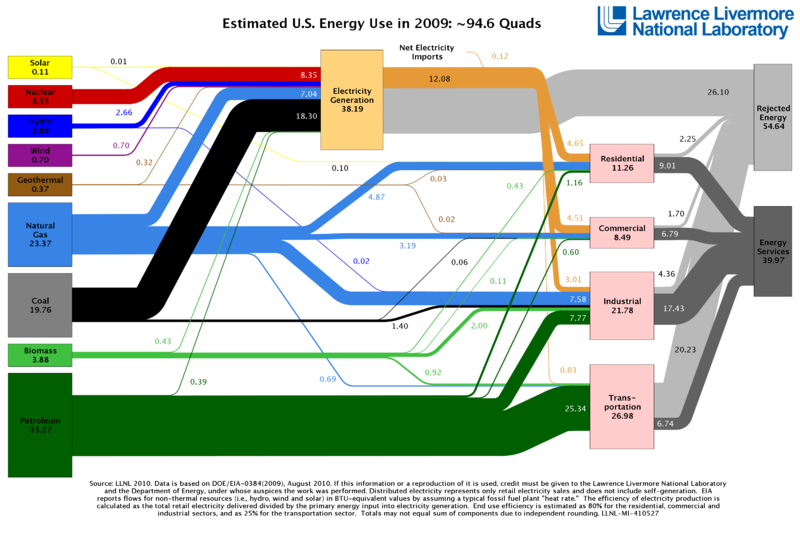
U.S. Energy Sources and Uses

Here is a very interesting chart from the Lawrence Livermore National Laboratory, that gives a great panoramic view of how energy flows in the U.S (click on it to expand).  Note that a quad means 1 quadrillion Btu -- that's 1 with 15 zeros.


Bloomberg.com also has an interactive version of the same graphic, with links to additional information, created by John Tozzi and David Yanofsky --most interesting: U.S. Energy: Where It’s From, Where It Goes, and What’s Wasted


Fossil Fuel Production and Use: Lots of Fun With Charts

This chart is a combination of three that I posted previously which give an overview of which countries produce and consume the most coal, oil and natural gas.


To make the above chart, I had to convert the coal, oil and gas numbers--which were denominated in short tons, barrels per day, and cubic feet--into the common unit of BTUs (British Thermal Units).  Arriving at the conversion factors can be a fairly technical exercise, of which there is good discussion here: http://www.aps.org/policy/reports/popa-reports/energy/units.cfm

I used the following factors, which were suggested as averages:
Oil: 1 barrel = 5.8 MBtu
Coal: 1 short ton =  25.2 MBtu
Natural Gas: 1 cubic foot = 1000 Btu

Global Natural Gas Production and Consumption

Over the last couple of weeks I published charts based on data from the U.S. Energy Information Administration that showed various countries' production and consumption of coal and oil.  Today I turn to the third fossil fuel, one which is gradually growing in importance in the U.S.: Natural Gas.


Natural gas is a resource which is mainly used for heating homes, industrial uses, and electrical power generation.

The chart shows that the U.S. and Russia are the largest producers of natural gas.  Russia exports a great deal of natural gas, while the U.S. consumed slightly more than it produced in 2010, although this may change in coming years, as the U.S. taps its huge supply of unconventional shale-based natural gas.  China is a surprisingly modest consumer of natural gas, and instead has an over-sized reliance on coal.

Change to U.S. Immigration Policy

Article: Wall Street Journal, U.S. Alters Policy on Deporting Immigrants, Miriam Jordan

from www.texastribune.org


As if in response to my post from earlier this week, Illegal Immigration and the Need for Reform, the Wall Street Journal reported today that the Obama administration would review the cases of 300,000 illegal immigrants and might allow some of them to apply for work permits, and remain in the country while the applications are pending.

According to the article, the number of deportations has increased under the Obama administration, but this new stricter policy is overwhelming immigration courts, which now have a backlog of around one year.

Part of the justification for changing the policy may be political (Obama needs the Hispanic vote), but it is also practical.   A draconian crack-down on illegal immigration is expensive, and I guess the politicians who push for this approach are to some degree playing to the xenophobia of their electorate.  Our agricultural industry, especially, needs these workers.  Immigration reform that works is what is needed, not more cops, jails and courts.

Wednesday, August 17, 2011

Bland Message from Patty, Max & John

Article: Wall Street Journal, Together We Can Beat the Deficit, by Patty Murray, Max Baucus and John Kerry

Senator Patty Murray Senator John Kerry Senator Max Baucus


Today's Wall Street Journal contained a rather bland article by the 3 Democratic Senators who are on the Joint Select Committee on Deficit Reduction.  What they say in the article is: we can do this; we have done it in the past; we need to work together.

I suppose it is only appropriate to start with a cordial, hopeful message.  I do hope they are right.

The committee's mandate is to find $1.5 trillion in deficit reduction over the next ten years.  If not, there will be mandatory across-the-board spending cuts in defense and non-defense spending--but not entitlements like Social Security and Medicare spending, which are the real long-term threats to the budget.  The idea is that the automatic cuts will be so distasteful to both parties that they will be forced to reach a consensus and propose a more practical set of measures (cost cuts and revenue enhancements) to help reduce the debt.

Joint Select Committee on Deficit Reduction

DemocratsRepublicans
Senate members
House members
(thanks, Wikipedia)

One major problem is that many Democrats have vowed to not touch entitlements, which is unrealistic and irresponsible, and many Republicans (all of the members of the committee, as I understand) have vowed not to raise taxes, which is unrealistic, irresponsible and unfair to boot.  Both of these stances may be largely based on political posturing, but my opinion is that the Republicans may be acting on a partial understanding that irresponsible actions on their part will hurt the economy and jobs, which will make it nearly impossible for President Obama to win the election in 2012.

The other problem, of course, is that economic growth is slowing, and massive ill-considered short-term cuts may be just the thing to tip the economy back into recession.  Of course, this is exactly what candidate Michele Bachmann is calling for when she says repeatedly that there is no need to raise the debt ceiling.  (Conservatives point out that Barack Obama said nearly the same thing when he was a junior Senator).  It's hard to know if Bachmann's statements are based on her own ignorance of economics, or if she knows better, and is simply pandering to a disgruntled electorate which is ignorant of economics.  I suppose it is the latter--she must know better.

I know better

Committees, aggressive time-frames, and automatic mechanisms aside, here is what is needed, and in this order:

Step 1 should be relatively easy: massive tax simplification and reform.  The Economist said that by one measure the tax compliance industry in the U.S. is 7 times the size of the automobile industry.  The government obviously needs to take our hard-earned money, but can't they do it in a simple straightforward way, which the average citizen can understand?  The first step to tax fairness is tax transparency and simplicity.  This is something both sides should be able to agree on, and it would go a long way to showing voters that government actually is capable of getting something right.  Obama should get behind this.  It will increase his credibility and will certainly be simpler to do than healthcare was.

Step 2 is harder: massive reform of entitlements, especially health care related entitlements like Medicare.  In his plan, Representative Paul Ryan noted that the average Medicare recipient puts just over $100 thousand into the system, and gets out somewhere around $300 thousand.  This is obviously unsustainable.   Fixing it will be difficult, and may have to be phased in over the long term.  I suspect it will have to entail a re-working of Obama-care, probably including the famous "public option" which may be the only way to have meaningful cost reductions.

Simple as that...